

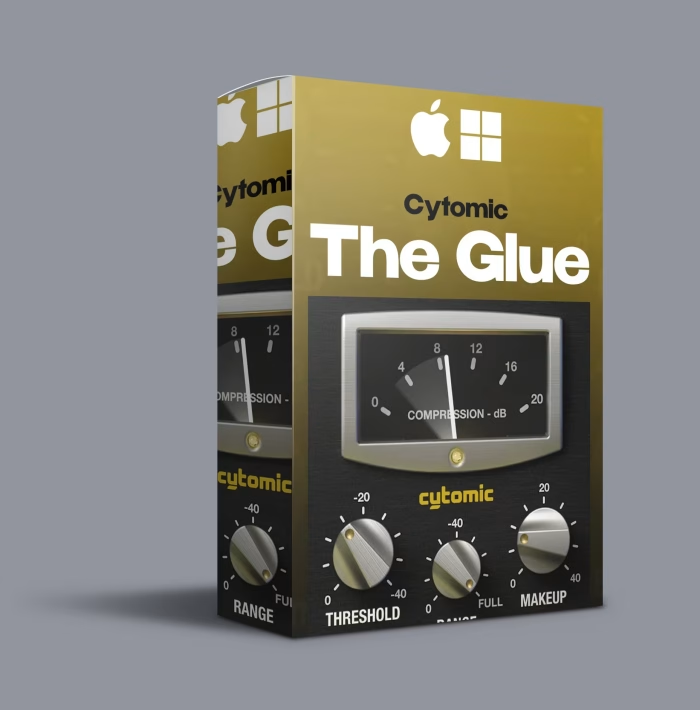

Ever had a drum buss that hits hard but lacks that cohesive feel? **Consequently**, standard bus compressors either squash the transients or never glue things together properly. **Ultimately**, the elusive gap — between “loud” and “together” — is exactly where **Cytomic The Glue VST** lives.
**Specifically**, **The Glue** is a component-level emulation of the SSL 4000 G-Series Bus Compressor — one of the most widely used mix buss compressors in music history. **Rather than** modelling general behaviour, Cytomic modelled every transistor, capacitor, and resistor in the original circuit. **As a result**, The Glue behaves identically to the hardware. **For instance**, it perfectly replicates how attack and release interact with program material, and how the VCA gain cell responds to different compression levels.
✅ After making a payment, you will receive:
❗– You receive a LIFETIME LICENSE for The Glue from Cytomic within max 24 hours ( THIS IS PRE-ORDER )
❗– 100% GUARANTEE on the product — you can always contact us for assistance
❗– License will be requested and delivered within the specified time. (Please be patient.)
🟠 100% OFFICIAL LICENSE for Cytomic The Glue from Cytomic
✅ Activation key provided via email — no iLok required
✅ Works on MacOS & Windows
✅ Constant updates to new versions
What the Cytomic The Glue VST Brings to Your Mix
At its core, The Glue is a single plugin with a focused feature set — and that focus is deliberate. **Indeed**, SSL’s G-Series bus compressor does one thing exceptionally well: it glues a mix together without destroying dynamics. **Furthermore**, modern features extend its usefulness well beyond what the hardware can do alone.
SSL G-Series Circuit Modelling at Component Level
**Undoubtedly**, what sets The Glue apart from other SSL bus compressor plugins is the modelling depth. **To begin with**, Cytomic analysed the original SSL 4000 G-Series schematic and modelled each component individually. **Moreover**, every element — the VCA gain cell, the timing capacitors, the transformer-coupled output stage — is simulated in real time.
**Crucially**, this matters because the original hardware’s behaviour changes depending on how hard you drive it. **For example**, push the threshold 2 dB and the compression feels musical. **Conversely**, crank it 10 dB, and the characteristics shift noticeably — the release stretches, the harmonics change, and the glue becomes more pronounced.
**Therefore**, The Glue reproduces this shift accurately. **Ultimately**, you get the same response as a £4,000 console channel, without the cost or maintenance.
**Additionally**, **The Glue** ships with two distinct voicings: “Old” and “New”. **Specifically**, in Old mode, the plugin models the original 1980s G-Series circuit with its softer knee and slower release curve. **By contrast**, the New mode is based on the revised 1990s version with tighter response and more aggressive compression. **Ultimately**, both modes are equally usable, since the choice depends entirely on your material.
HPF Sidechain — Stop Pumping Before It Starts
**Notably**, one of the most practical features of The Glue is its high-pass filter on the sidechain circuit. **Generally**, when compressing a full mix or drum buss, low frequencies — especially kick drums and 808s — trigger the compressor harder than the rest of the material. **Consequently**, this causes the classic “pumping” sound where the whole mix breathes with every kick hit.
**Thankfully**, the HPF sidechain lets you route those low frequencies out of the detector circuit. **For instance**, set the filter to 60 Hz, 90 Hz, or 150 Hz, and the compressor ignores kick energy while still reacting to the midrange and high-frequency content. **As a result**, you get glue from the mids and highs without the low end causing rhythmic gain reduction.
Mix Control and Clip Mode
**Moreover**, **The Glue** includes a Mix knob for parallel compression. **Thus**, you can blend the compressed signal with the dry signal without routing through aux tracks. **Indeed**, this is especially useful for drum buss compression where you want cohesion but need to preserve the original transient attack.
**Additionally**, Clip mode adds hard-clipping saturation at the output stage. **Specifically**, when engaged, the signal clips when it exceeds 0 dBFS. **However**, this is not a replacement for a limiter. **Instead**, it adds harmonic content and perceived loudness when used subtly. **For example**, on drum busses, Clip mode adds presence without the distortion that harsh limiting introduces.
Who Should Use The Glue VST
**Primarily**, **The Glue** fits three specific workflows. **First**, mixing engineers using a buss compressor on their stereo output. **Second**, producers who want drum buss compression with sidechain control. **Third**, engineers mixing hybrid ITB/analog setups who need SSL console character on individual subgroups.
Mix Buss Glue
**To start**, insert The Glue as the first plugin on your master buss. **Next**, use a 2:1 ratio with the threshold where you get 2–4 dB of gain reduction, attack at 30 ms, and release on Auto. **Then**, engage the HPF sidechain at 60 Hz to keep the low end solid. **Consequently**, the mix tightens without sounding over-compressed.
**Furthermore**, for a detailed breakdown of how buss compression affects different genres, Sound On Sound’s guide to bus compression covers attack and release timing across rock, pop, and electronic mixes.
Drum Buss Compression
**Alternatively**, on drum busses, set the ratio to 4:1 with a 10 ms attack, 0.1 ms manual release, and HPF at 90 Hz. **Because** a faster attack catches transient peaks, this manual release prevents pumping with the kick. **Meanwhile**, the HPF keeps the kick and snare punchy. **Furthermore**, use the Mix knob to blend 30–50% wet for parallel compression.
**Moreover**, The Glue pairs naturally with our VST plugins collection for additional processing options. **For instance**, try it before an EQ for a classic hardware-style channel strip.
Subgroup Processing
**Similarly**, dial in a 2:1 ratio with slow attack (30 ms) and Auto release on sub-groups like background vocals, synth stacks, or guitar layers. **In this way**, the compressor catches level inconsistencies without drawing attention to itself. **Subsequently**, your subgroup sums before the master buss compressor, keeping the overall mix cleaner.
The Glue VST — Technical Specifications
⚙ Specifications
- • Plugin Formats: VST3, AU, AAX (64-bit)
- • OS: macOS 10.12+ (Intel & Apple Silicon native), Windows 10+ (64-bit)
- • Supported DAWs: Ableton Live, FL Studio, Logic Pro, Cubase, Studio One, Pro Tools, Reaper, Bitwig, Nuendo
- • Disk Space: 150 MB
- • RAM: 512 MB minimum (4 GB+ recommended)
- • Activation: Serial key delivered via email — no iLok required, no dongle needed
- • Copy Protection: Machine-based authorization (3 simultaneous activations)
What’s Included in the Cytomic The Glue VST
✅ What’s Included
- ✓ Cytomic The Glue VST — Full SSL G-Series Bus Compressor emulation
- ✓ Component-level circuit modelling — Individual transistor, capacitor, and resistor modelling
- ✓ Old & New modes — Original 1980s circuit and revised 1990s response
- ✓ HPF Sidechain — High-pass filter on detector circuit at 60 Hz, 90 Hz, 150 Hz
- ✓ Mix control — Wet/dry blend for parallel compression
- ✓ Clip mode — Hard-clipping output saturation
- ✓ Auto release & manual release — Program-dependent or user-defined timing
- ✓ Factory presets — 20+ presets for mix buss, drum buss, subgroups, and parallel
- ✓ VST3, AU & AAX formats — Works in every major 64-bit DAW
- ✓ Mac & Windows — Intel & Apple Silicon native
- ✓ Scalable UI — Resizable interface for high-DPI displays
- ✓ Royalty-free — Use in commercial releases with no restrictions
Frequently Asked Questions
📋 Frequently Asked Questions
🔧 Compatibility & System Requirements
✓ What DAWs are compatible with The Glue VST?
Primarily, The Glue supports VST3, AU, and AAX formats. Therefore, it works in Ableton Live, FL Studio, Logic Pro, Cubase, Studio One, Pro Tools, Reaper, Bitwig, Nuendo, and any 64-bit DAW that accepts these formats. Additionally, both macOS and Windows are fully supported.
✓ Does The Glue run natively on Apple Silicon?
Yes, absolutely. Specifically, The Glue runs natively on Apple Silicon (M1, M2, M3, M4) without Rosetta. Furthermore, Intel Macs with macOS 10.12+ and Windows 10+ (64-bit) are fully supported as well.
✓ Do I need an iLok or dongle to use The Glue?
No, you do not need an iLok. Instead, The Glue uses machine-based authorization. Consequently, your serial key is delivered via email, and you activate directly in the plugin. Thus, no iLok, no dongle, and no cloud-based activation are required. Additionally, you get 3 simultaneous activations for use on multiple computers.
🔑 Licensing & Activation
✓ Is this the full licensed version of The Glue?
Indeed, this is the real deal. Specifically, this carries a full, official license for Cytomic The Glue — not a demo or trial version. Therefore, it includes all features with no limitations, audio muting, or time restrictions.
✓ How do I install and activate The Glue?
First, after purchase, you will receive a download link and activation key via email within 24 hours. Next, download the installer, run it, open your DAW, load the plugin, and enter the serial key in the activation window. Ultimately, no iLok account or physical dongle is required.
🎙️ Usage & Support
✓ Can I use The Glue on commercial releases?
Absolutely, it is 100% royalty-free. Therefore, you can use it on streaming platforms, sync licensing, YouTube content, client projects, or personal work. In short, no additional fees or reporting are required.
✓ What’s the difference between Old and New mode?
Specifically, Old mode models the original 1980s G-Series circuit with a softer knee and slower release — ideal for gentle mix buss compression. On the other hand, New mode is based on the revised 1990s version with tighter response, faster release, and more aggressive compression. Ultimately, both are usable on any source; it simply depends on whether you want smoother or punchier behaviour.
✓ What is the refund policy?
Importantly, due to the digital nature of the product, all sales are final. Therefore, please review our Refund Policy for full details before completing your purchase.
Why The Glue VST Belongs in Your Mixing Toolkit
**Admittedly**, you can glue a mix with stock compressors — many engineers do, and some get good results. **However**, the reason SSL’s G-Series bus compressor has been a studio standard for forty years is not nostalgia. **Rather**, it is the way the VCA gain cell, the timing network, and the output transformer interact as a unified system. **Therefore**, The Glue brings that interaction into your DAW with component-level DSP that models the original hardware circuit instead of approximating it.
**Furthermore**, The Glue handles the hardest part of mix buss processing. **Specifically**, applying enough compression to glue the mix together without squashing dynamics or causing pumping. **In addition**, the HPF sidechain and mix control give you flexibility that the original hardware does not offer. **Together**, they make The Glue usable on everything from a dense rock mix to a sparse electronic arrangement.
**Finally**, for additional mixing tools to pair with The Glue, check out our VST plugins collection and full range of audio processing plugins available on VSTor.
Add console-grade buss compression to your DAW.
Cytomic The Glue — component-modelled SSL G-Series bus compressor.
$149
Secure checkout · Instant delivery · Official Cytomic license
Be the first to review “Cytomic The Glue VST – SSL G-Series Bus Compressor Plugin”
You must be logged in to post a review.
Related products
VST Plug-ins
VST Instruments
VST Instruments
VST Plug-ins
VST Plug-ins

Sound Loops & Samples
StudioLinked – Modernize VST + Festival Trap, EDM Trap EXPANSIONS
Reviews
There are no reviews yet.